Introducing Actual Freedom
Actual Freedom – The Third Alternative
|
Please note that the entire text of the Introduction was written by the feeling-being ‘Peter’ while ‘he’ lived
in a pragmatic (methodological), still-in-control/same-way-of-being Virtual Freedom before becoming actually free. |

|
|
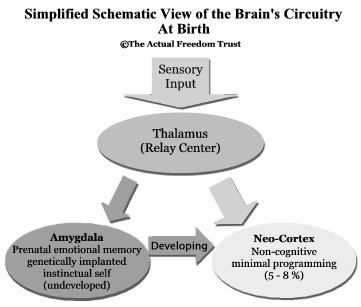
To recap again … at birth we come genetically pre-coded
with an instinctual ‘self’ that is fully developed by about the age of 2 years. This coincides with the first obvious signs of the
instinctual passions of fear, aggression, nurture and desire in every infant’s behaviour.
|
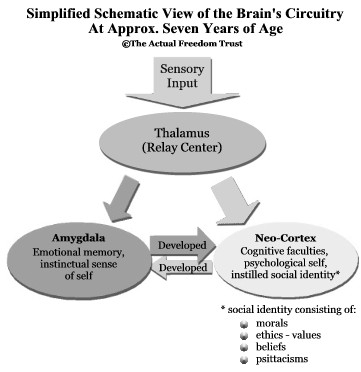
With the first signs of the emergence of this
instinctual behaviour we begin to be instilled by our peers with a social identity consisting of morals – ‘good’ and ‘bad’ –
and ethics – ‘right’ and ‘wrong’ – together with a full set of social beliefs and psittacisms.
This social identity is instilled essentially to
curb the excesses of the instinctual passions and to make one a fit member of society. This identity is one’s ‘inner policeman’ and
must be investigated first if one wishes to eliminate the instinctual passions. |
|
|

|
|
One’s social identity is the conglomerate of all the beliefs, morals,
ethics, values, principles and psittacisms that each of us have been programmed with since birth. It is only when one has substantially
eliminated or deleted this programming that one can clearly look at, and sensibly investigate, the core instinctual being hidden beneath. This
is a crucial step on the path to Actual Freedom and it is both radical and iconoclastic.
The elimination of one’s social identity requires the replacement of society’s moral and
ethical arbitrary judgments of good and bad and right and wrong with an open-eyed evaluation and intelligent assessment based on what is
sensible and what is silly. This step can only be undertaken with the pure intent gleaned from the pure consciousness experience – an
experience of the purity, perfection and innate benign disposition evident in a ‘self’-less state. This gives one the confidence and
surety to venture beyond the limits of what is normally considered to be safe, sensible and sane.
The other essential work that is needed to dis-empower one’s social identity is that the beliefs
and psittacisms one has been instilled with in childhood, or has later co-opted as one’s own, need to be replaced with observable and
verifiable facts.
Both these processes, if undertaken with diligence and sincerity, will cause one’s social
identity to wilt and wither thereby allowing clear thinking, sensible action and considered regard for all of one’s fellow human beings, no
matter what age, gender, race, class or culture. |
|

|
|
As your attentiveness gets up and running you will soon discover that many of your
antagonistic and sorrowful feelings are directly associated with your beliefs. You discover that invariably you fight to defend your beliefs
and feel threatened if you feel your beliefs are being challenged. You will discover that many of your beliefs are either escapist fantasies
or doomsday visions, archaic superstitions or imaginary scenarios, none of which are conducive to your feeling happy or to your being
harmless.
A discerning eye and ear is needed in order to ascertain what is fact and what is merely belief,
theory, concept, assumption, speculation, conviction, imagination, myth, wisdom, or truth. It is easy to see when one knows how to look. Any
belief is nonsensical. By its very nature a belief is not factually true ... otherwise it would not need to be believed to be true.
A fact is obvious; it is out in the open, freely available for all to see. To believe something to
be true is to accept on trust that it is so. A fact does not have to be accepted on trust – a fact is candidly so. A fact is patently true,
manifestly clear. A fact is what is ascertained sensately and thus demonstrably true. If you are to become free of believing you need to rely
on fact – the verifiable, objective actuality – as a touchstone to test the sensibility of whatever ‘truth’ one suspects to be a
belief.
A feeling is not a fact. Feelings have led human beings astray for millennia, without ever being
questioned as to whether they are the correct tools for determining the facts of a matter. Feelings are held to be sacrosanct; they are given
a credibility they do not deserve. They are seen to be the final arbiter in any contentious issue: ‘It’s my gut-feeling’, or ‘My
intuition is never wrong’, or ‘It feels right’, and so on. Thinking, shackled by belief and feeling cannot operate with the clarity and
benignity it is capable of.
|
|

|
|
We have seen that our field of experiential investigation is both one’s
psychological ‘self’ and one’s instinctual ‘self’. The on-going attentiveness initiated by asking oneself ‘How am I experiencing
this moment of being alive?’ allows one to initially focus one’s awareness on the activities of the psychological ‘self’ – the
mental-emotional identity that is ‘who’ we think we are.
This awareness, and the subsequent investigations, operates in actively demolishing the social
identity – the morals, ethics, values, beliefs and psittacisms instilled by one’s peers in order to keep the instinctual passions ‘under
control’. One is literally reprogramming one’s own brain to allow what is sensible, factual, and materially evidenced to become
increasingly obvious and apparent – as opposed to what is illusionary and merely affectively or cerebrally ‘experienced’.
This then allows one’s awareness to become increasingly free and bare, allowing one to clearly
see the over-arching role that feelings and emotions have in causing one to be malicious and sorrowful, and one finds that one can radically
reduce their influence in one’s life with pure intent operating.
These two facets – demolishing the social identity, the ‘guardian at the gate’
of the animal instinctual passions, and reducing the influence of affective feelings and emotions in one’s daily life – both the
supposed ‘good’ and ‘bad’ – ultimately brings one’s bare awareness to focus on one’s animal instinctual programming – the very
root cause of human malice and sorrow. |
|

and leaving the ancient past behind …
|
|
The instinctual animal ‘self’ is much more sophisticated in humans than in other
animals in that the human cognitive neo-cortex is flushed with chemical flows triggered by the non-cognitive primitive brain and these
chemicals are felt as emotions or basic passions and thus interpreted as ‘my’ deep-seated feelings. Thus, one feels this genetic
instinctual programming to be ‘me’ at my very core.
When one digs deep into one’s instinctual ‘self’ one encounters the raw unfettered instinctual
passions, mainly those of fear, aggression, nurture and desire and when one does this one needs to ‘ride out the storm’ of chemical-induced
fears and fantasies that are invariably stirred up. Also in the experiential investigation of the instinctual passions one inevitably
encounters the instinctual archaic ‘memory’ imprinted in the primitive brain itself, a memory that stretches back to the very beginnings of
the human species itself.
This instinctual memory serves to maintain both one’s bondage to the ancient past and to Humanity
itself. Thus, an in-depth investigation of one’s instinctual ‘self’ can provoke ancient atavistic fears and dread that can be daunting,
to say the least. This is why pure intent and a good dose of bloody-mindedness and stubborn persistence is essential at this stage.
Whilst this crude genetically-encoded survival programming was essential in the past, to ensure the
survival of the species, to set about to deliberately eliminate this programming is to feel oneself to be, at a very primal level, a traitor to
Humanity.
However, these fascinating experiences and discoveries leave no emotional scars and soon one is back
on the wide and wondrous path to actual freedom … |
|
click here to continue |

Text, Design & Images ©The Actual Freedom Trust: 1997-. All Rights Reserved.
Disclaimer and Use Restrictions and Guarantee of Authenticity and Use Restrictions and Guarantee of Authenticity Image Credits |